Tuesday, March 15, 2016

Astronaut Scott Kelly configures UC San Diego-led experiment aboard the International Space Station

Wayne Wright, Tracy Neff, Scott Kelly, Jennifer Storck, astronaut Mike Fossum and Sharon Reinke met at the Johnson Space Flight Center in December 2014 to train Kelly to use the fluids and combustion experiment hardware on the space station.
Credits: NASA

It’s not every day that researchers at UC San Diego can enlist a NASA astronaut to tweak their experimental set-up, but when duty calls, Scott Kelly is at the ready.  
 
The astronaut, who returned to Earth two weeks ago following a one-year mission aboard the International Space Station, made crucial adjustments during his mission to an experiment led by Forman Williams, a professor of mechanical and aerospace engineering at the University of California, San Diego. Williams’ Flame Extinguishment Experiment (FLEX) study – one of several microgravity experiments being run on the ISS’s Destiny Laboratory – is an effort to learn more about so-called cool-burning flames, which could lead to the production of safer spacecraft as well as cleaner, more efficient engines for vehicles back on earth.

Kelly spent two consecutive days configuring test hardware to perform test points for the FLEX system. He also replaced needles, a fiber arm, igniter tips and reservoirs in support of the experiments.

All the FLEX experiments take place in the ISS’s Multiuser Droplet Combustion Apparatus, which can generate and ignite droplets from different fuels in different atmospheric conditions. The chamber is crammed with sensors and equipped with video cameras that record experiments. It’s located inside an experimental facility called the Combustion Integrated Rack, which is roughly the size of a 5.5-foot bookcase, weighs close to 560 lbs and records the data for transmission back to Earth.

Researchers believe that cool flames – which were discovered during an experiment aboard the ISS in 2014 – are the result of elementary chemical reactions that do not have the time to develop around burning fuel droplets on earth, where they can only exist for a very short period of time. The FLEX study seeks to learn more about how quickly fuel burns, the conditions required for soot to form, and how mixtures of fuels evaporate before burning. The microgravity environment of the ISS, where there is no buoyancy, makes it possible to provide a sufficient amount of test time required to support the chemical process that creates cool flames.
Press release from NASA: 
http://www.nasa.gov/feature/kelly-contributed-to-fluid-and-combustion-research

Related story:  Researchers discover cool-burning flames in space


Monday, March 14, 2016

Celebrating Pi Day


March 14th was Pi Day! Students from the UC San Diego chapter of Tau Beta Pi, a national engineering honors society, celebrate Pi Day every year by dropping pie from EBUII.


This year, the pie was made of mayonnaise and fell apart in mid-air!
Everyone got free pizza and pie - IF they could answer an engineering question. Many of the questions involved converting radians to pi.


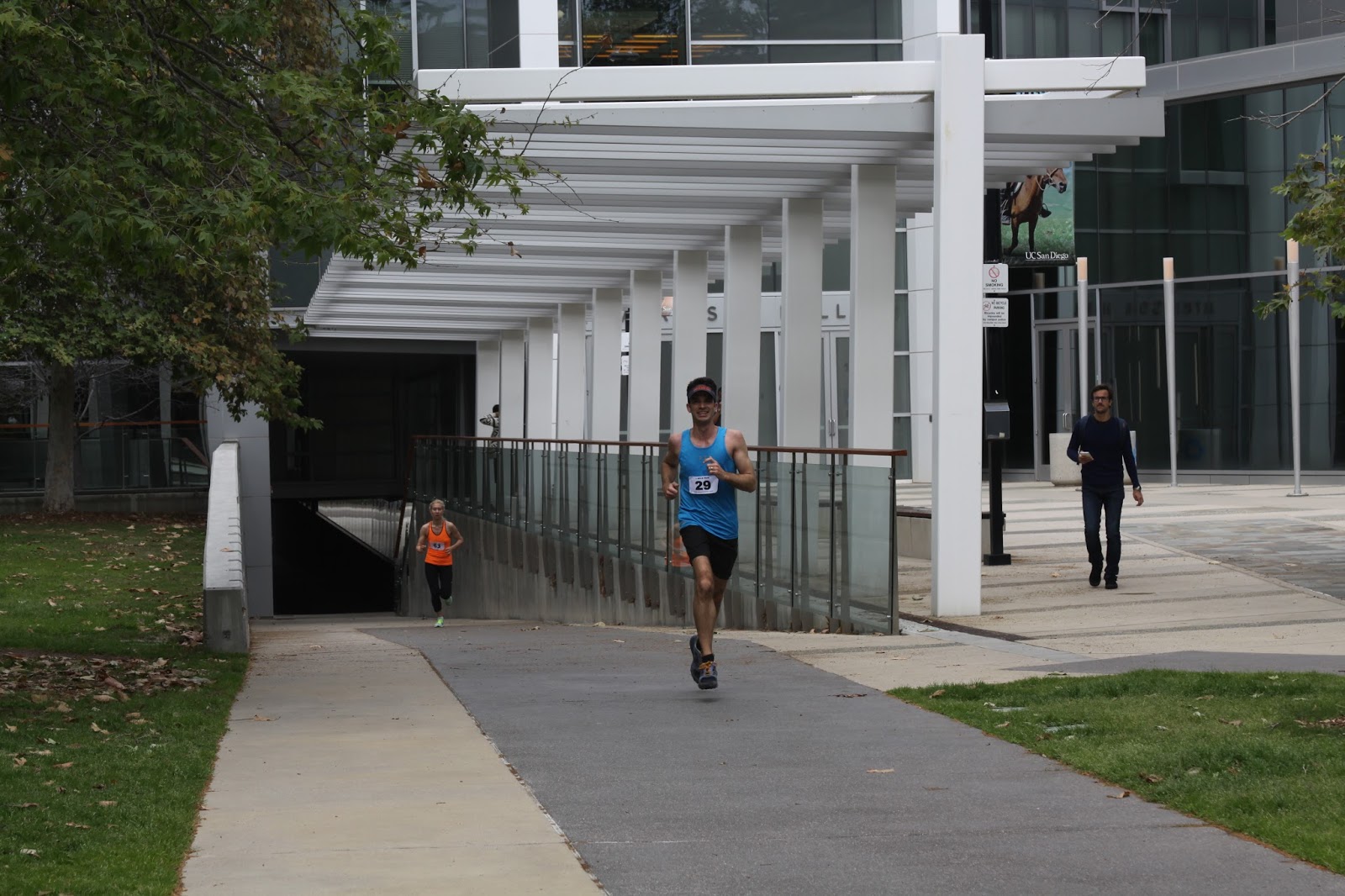
Undergraduate Daniel Gonzalez came in first in this year's Pi Mile Run
Engineering students also braved finals week and a light drizzle to celebrate Pi Day by running 3.14 miles and enjoying a well-deserved slice of apple pie after.

This year, the Department of NanoEngineering captured the first three places. Daniel Gonzalez, a senior, completed the race course in just 18'36". A triathlete, he showed up for the March 14 race to have fun, he said. Darren Lipomi, an assistant professor and half-marathon runner, came in third.
Meanwhile, Iana Volvach, a Ph.D. student in the research group of ECE Professor Vitali Lomakin, was the first woman to cross the finish line.

In all, more than 60 registered for the run and helped raised about $700 for the San Diego Science Alliance.

Darren Lipomi, faculty member from the Department of NanoEngineering, is close to crossing the finish line.


#ILookLikeAnEngineer: Christopher Yin

Meet Chris, the next student of our campaign and VP Project Team for Engineering World Health. With a passion for improved global health, he hopes to impact entire populations through engineering - all while listening to The Velvet Underground and doing some creative writing. 

Name: Christopher Yin
Major: Bioengineering
Graduation Date: 2018


Why did you choose engineering at UC San Diego?
When I was applying to schools, I wasn’t even really considering UC San Diego. I was set on attending a private university, and if that didn’t work out and I had to choose a UC, then, of course, it would have to be Berkeley. The only reason I included UC San Diego was because I saw that its bioengineering program was ranked second in the nation. I attended Triton Day and  realized that it’s a great school for engineering. There are a ton of resources available for research and a number of engineering organizations on campus - those were primarily what drew me here.


What are your career goals?
I want to pursue either a Ph.D. or an M.D./Ph.D. program. I like being in school, and I like learning. Ultimately, I want to be involved in research that has an impact on global health. I love the science and I want to understand as much as I can, but I also really appreciate the part of engineering where you actually build your solutions. It’s pretty satisfying to make something tangible, and especially to have that something matter to other people. Engineering represents the opportunity to affect not just individuals, but entire populations.


Do you have a favorite quote or mantra?
From David Foster Wallace’s Infinite Jest: “I do things like get in a taxi and say, ‘The library, and step on it.’”


What are three things that are unique about you?
(1) Along with being a bioengineer, I would also like to write stories and novels. (2) I love brussel sprouts. (3) I listen to old and weird music, like The Velvet Underground, King Khan and BBQ Show.


What does this campaign mean to you?
The only way I can think to answer this question is with something platitudinous like, “It’s important for people’s awareness of engineering to encompass the full breadth and diversity of the people who do the engineering.” But just because it sounds cliché doesn’t mean it’s not true. I still think there needs to be a greater push early-on in education for all students, regardless of race, gender, religion, sexuality, etc., to explore STEM fields and figure out for themselves if it’s something they want to pursue. From my experience, any demographic disparities are due not so much to a lack of ability or opportunity, but a lack of awareness of ability and opportunity. If campaigns like this could change that, then that would be pretty great.

Friday, March 11, 2016

Structural Engineering and Visual Arts Students To Exhibit Final Projects Mar. 14-17

Students from a structural engineering and a visual arts class are working together, shoulder to shoulder, on a collaborative final project. They will showcase the results of this collaboration at the Envision: The Future is Here exhibition. 

The projects will be on public display in the Structural and Materials Engineering building, rooms 201 and 202, Mar. 14-17, from 10:00 a.m. - 5:00 p.m each day, with a reception to be held on the 17th at 7:00 p.m. 

This experimental class, happening in the new EnVision Maker Studio at UC San Diego, blends the pedagogical needs of artists and engineers. The goal is for the students to work collectively to create a “whole object” where the aesthetics and design of the sub-structure and art object are integrated in such a way that they work together aesthetically, conceptually, and structurally.

The artist in each group led the design and 3D printing or other assembly method for a 3D object representing their idea of science fiction. The engineers took the lead on the surrounding structure. Some of the projects include:
  • A squid monster sculpture on a pagoda-style structure
  • A suspended car sculpture 
  • A third team is constructing something akin to the big tic-tac-toe systems you see in playgrounds
Learn more about EnVision here.

Thursday, March 10, 2016

Freshman bioengineering students 3D print bones in hands-on class


UC San Diego bioengineering undergraduates are close to wrapping up the winter quarter of a new hands-on bioengineering course designed to expose freshmen to central topics and tools of bioengineering work on three hands-on projects. The class meets in the new EnVision Maker Studio at UC San Diego and is part of the Jacobs School's Experience Engineering Initiative.

* Electrophysiology
* Glucose monitoring for the blind
* 3-D bone printing


Rachel Daniels, a student in the class, says she learned a lot about the human spine from the bone printing project.

"By analyzing real life CT scans we were able to pull important data, allowing us to print a replica of the T10 vertebrae using plastic printing material," she said. "Once several prints were made we tested the correlation between load and displacement in the inter-vertebral disks by simply placing varying forces upon the vertebrae and measuring displacement. We concluded the heavier the load, the larger the total displacement until a plateau was reached."

We wrote about the very first iteration of this experiential bioengineering course in Pulse magazine last summer.

Below are images from the course.


Tools used include BioRadios, MATLAB, CAD software, 3D printers, foam cutters, hand tools.

Tuesday, March 8, 2016

Next generation of battery tech at ARPA-E Technology Showcase


Sustainable Power and Energy Center booth at the ARPA-E Technology Showcase.
A new UC San Diego technology that enables lithium-ion batteries to run at record low temperatures could be useful for the electric vehicles of the future, and this in turn could help address “range anxiety,” especially in cold weather. This project was among the 250+ innovative energy technologies presented at the Advanced Research Projects Agency - Energy (ARPA-E) Technology showcase last week in Washington, D.C.

"We hope this technology extends electric vehicle operation in cold climates, which is currently a known limitation of current electric vehicles," said Cyrus Rustomji, a postdoc in the Sustainable Power and Energy Center (SPEC) at UC San Diego and lead researcher of the project. Rustomji earned his Ph.D. in materials science from UC San Diego in 2015 and now does research with nanoengineering professor Shirley Meng, director of SPEC.

(L-R): Director of ARPA-E Dr. Ellen Williams, Prof. Shirley Meng (director of SPEC at UC San Diego) and Cyrus Rustomji (UC San Diego postdoctoral researcher).
The technology could also enable lithium-ion batteries to operate in extreme environment applications, such as heavy-duty automotive engine cold-start, high-atmosphere drones or balloons, and aerospace missions.

Lithium-ion batteries are commonly found in most rechargeable electronic devices and electric cars. Some advantages of lithium-ion batteries are they charge fairly quickly and don't need to be drained before recharging. But like other batteries, their performance suffers in the cold. That's because because the chemical reactions inside the batteries slow down at low temperatures.

Lithium-ion batteries typically have a low temperature limit of -20 degrees Celsius. The technology developed by Rustomji and coworkers extends lithium-ion battery operation to as low as -60 degrees Celsius. Researchers achieved this exceptionally wide temperature range by replacing the conventional liquid electrolyte in lithium-ion batteries with a liquefied gas electrolyte that's stored under mild pressures.

"Such a chemistry has never been utilized for energy storage devices," said Rustomji. "Most battery technology utilizes a liquid based electrolyte, and a lot of focus is now turning towards solid state electrolytes. But it seems that nobody has yet thought to explore the possibilities of a gaseous type electrolyte. This opens up a new window of electrochemistry in which there are many possible applications and basic science principles to be studied beyond just the energy storage devices we have explored."

The technology garnered much interest during the ARPA-E Technology Showcase. "Visitors were very curious about the technology because it uses a non-conventional electrolyte system, and the low-temperature performance may enable some of their own applications. A scientist from the Jet Propulsion Laboratory was very delighted to see our results and invited us to discuss further and for a possible collaboration," said Rustomji.

Cyrus Rustomji (right) presents a poster of the project titled, "Liquefied Gas Electrolytes for Low Temperature Energy Storage."
Prof. Shirley Meng (left) discusses the project with Werner Kaufmann (right), a technology scout from BASF.
Technology discussion at the SPEC booth including Cyrus Rustomji (left), Prof. Shirley Meng (right) and Dr. Ellen Williams, Director of ARPA-E (second from right).


Cyrus Rustomji (left) demos UC San Diego technology at the SPEC booth at ARPA-E Technology Showcase.

Rustomji's startup, South 8 Technologies, Inc., is working to license and commercialize the liquefied gas electrolyte for applications in the automotive, high-atmosphere and aerospace markets. The company is also seeking partners, investors and funding opportunities.

Visit the Sustainable Power and Energy Center site to keep up with the latest technologies in energy generation, storage and conversion from UC San Diego.

Monday, March 7, 2016

Engineering World Health Hosts HealthHack 2016

The UC San Diego chapter of Engineering World Health held its second annual HealthHack February 27-28, garnering over 110 students of varied engineering and health science majors to produce a prototype or design to solve a serious global health problem.


The teams, comprised of up to four people, were given the following challenge: “To diagnose, limit, prevent, or treat a mental condition and its associated problems. Empower a patient to curb dependence on inaccessible resources, specifically in a low-resource setting.”

Neel Parekh, President Project Team for EWH, described what generated the prompt for HealthHack was what he sees as a significant need.

“I guess the simple answer is that mental health solutions are just not represented well in the engineering community,” Parekh said. “Engineers often focus on infectious and chronic diseases, but tend to give up when it comes to mental health. I also researched the [statistics] and felt bad myself for kind of not contributing to that realm enough, and [I] decided to pursue it further until I realized that there could be some really interesting engineering solutions to these mental health issues.”

According to the World Health Organization, countries with low and lower middle incomes carry almost three-quarters of neuropsychiatric disorders worldwide. Almost one-third of countries do not have a defined budget for mental health. Even more so, roughly 21 percent of countries that do have specific mental health budgets provide less than 1 percent of their total health budget on mental health.

The competition consisted of 27 hours of hacking, with the aid of graduate student, faculty, and industry mentors. Additionally, all participants had Arduinos and access to the MAE Design Studio at their disposal, in addition to workshops on 3D Printing and Hardware. Teams had to submit a written proposal, outlining the current need for the prototype or device, explanation of the solution, process for implementation, and any limitations and potential collaborations.


The first round of judging was a project expo, in which the 23 teams that submitted final proposals delivered 3-minute pitches to judges from academia and industry. Six finalists were selected for the last round. After a keynote speech from Illumina representative Adrian Fawcett, each team gave an 8-minute presentation before a panel of judges, including representatives from ResMed, the von Liebig Entrepreneurism Center and UC San Diego. 

Prototypes and designs included:
  • Hidden watch for anxiety and epilepsy
  • Wearable headband to aid narcolepsy patients 
  • Mobile game for individuals affected by autism spectrum disorder
  • Whole cell biosensor for a holistic approach to depression, bipolar disorder, anxiety and ADHD
  • Stuffed animals to comfort those suffering from depression 
  • Mobile app that tracks diet and physical health to improve awareness and self-diagnosis of depression, schizophrenia, obsessive compulsive and bipolar disorders
  • Aid for refugees suffering from PTSD
  • Focus on maternal stress and cortisol levels 
  • Isolation prevention for the mentally distressed  
  • Game that improves independence for the depressed, without having the affected realize the game is for treatment
  • Application of radio frequency to provide diagnostic information for PTSD patients 
  • Aid for the chronically homeless affected by mental and behavioral disorders
  • Game for young adults suffering from depression 


Finalists


Third Place: PEN
Rodolfo Flores, Applied Mathematics, ‘18
Alfredo Lucas, Bioengineering: Bioengineering ‘18
Gustavo Umbelino, Computer Science, ’18

Focused on ADHD, in particular students who easily fall under in-class distractions, the team developed a Stimulating Pen that sends constant reminders to the users through vibrations and visual cues. The device also has a component for anxiety relief that allows the user to continuously press the button on the pen’s top, similarly to clicking a pen nonstop. The incidence of ADHD is higher amongst impoverished individuals, correlating income with the disease’s prevalence.


Second Place: Calm Cap
Neha Chhugani, Bioengineering: Biosystems, ‘19
Anokhi Saklecha, Biochemistry and Cell Biology, ‘19
Renu Singh, Bioengineering: Bioinformatics, ‘18
Vaish Sridharan, Bioengineering: Bioengineering, ‘19

These four girls were awarded $500 in prize money for their $5 wearable head device that alleviates anxiety, the most prevalent neuropsychiatric disorder worldwide. The device utilizes acupressure beads at acupressure points GV 24.5 and GV 20, cerebral regions that the International Anesethesia Research Study reports to correlate with stress relief. In addition, the device includes a battery-operated sound chip that plays calming music or meditation instructions and a microprocessor that records frequencies and durations of panic attacks. Calm Cap is worn at patient’s discretions, such that they may put on the device when they feel a panic attack approaching, and they may do so without any additional aid.


First Place: Amniotic Wrap
Niranjanaa Jeeva, Bioengineering: Bioengineering, ‘19
Ella Stimson, Bioengineering: Bioengineering, ‘19
Julie Yip, Bioengineering: Biotechnology, ’18
                                   
With the prize money of $1000, the team looks forward to collaborating with the von Liebig Entrepreneurism Center to further develop their prototype. The team was focused on Postpartum Depression, a disorder that affects 15 percent of mothers after giving birth, and this condition affects almost twice as many women in underdeveloped countries in comparison to industrialized countries.

One of the symptoms of PPD is difficulty bonding with the infant, thus, the team created a blanket that connects mother to child. The baby has a small sock with Lilypad Arduinos and infrared sensors, which detect the baby’s pulse and therefore its heart rate. This heart rate is sent via Bluetooth the mother’s blanket, which has Lilypad Arduinos and vibrational motors that mimic the baby’s heart beat. A study at the Eindhoven University of Technology revealed that biosignals of an individual’s heart beat can form an intimate connection and interpersonal distance with another person. In addition, the changes in the infant’s heart rate will be analyzed to gently awaken and notify the mother, before hearing the cries of her child. Estimated at $12 in cost, the design strengthens the mother-infant bond and has potential to relieve other symptoms of PPD, allowing the mother to independently improve her health in the comfort of her home.

First year Bioengineering student Niranjanaa Jeeva expressed her surprise, noting her attendance was derived in her hope to develop more engineering skills, and she noted how competing was a humbling experience.

“HealthHack was definitely an exciting experience!” Jeeva told the Jacobs School. “I went into it hoping to learn a few engineering skills, maybe create a viable idea to present at the end of the weekend. As a first year, I believed that there was really no way that I could win. Luckily, I was part of a great team. Together, we worked hard through many frustrating hours to come up with our idea and had a great time doing it. Maybe it was because I was so exhausted by the end of the second day, but I was so surprised when we won. All the other teams who competed had such amazing ideas. I am so grateful for the chance to have met and competed with such creative and innovative people!”

Ella Stimson, also a first year Bioengineering student of Amniotic Wrap, described how the event has encouraged her to further pursue engineering for improved quality of life and global health.

“Initially, I joined for the experience and not so much for the competition itself,” Stimson said. “This mindset continued until our group found a topic and design idea that all of us were passionate about,” Stimson said. “I’m thrilled that our enthusiasm was reflected in our product and supported by others. This competition made me realize that there are so many areas of our world’s health that is lacking resources and help and it amazes me that just 24 hours of designing and hacking can make an impact in that - whether it’s our group or any of the other groups’ idea. Now, I really want to make sure that our idea gets out there in the world and makes some kind of difference.”


As for the future of HealthHack competition, Parekh said to the Jacobs School, “I just want the idea that engineers can contribute to global health to continue to prosper and…have the UCSD community of engineering, including professors, entrepreneurship, and administration, to understand that they should be conducive to students that can come up with really amazing things.”