Mesenchymal stem cells—adult stem cells that are constantly renewing our bone, cartilage, and muscle—can be stimulated by a gentle massage to release calcium. Bioengineers at UC San Diego published their findings in the February issue of eLife and their work has been recently featured online in BioTechniques.
Understanding how mesenchymal stem cells respond to physical forces in the body, such as blood flow or exercise, is important for a variety of diseases ranging from diabetes to spinal cord injury. Research led by Yingxiao (Peter) Wang, associate professor of bioengineering, shows exactly how pushing and pulling the outsides of these cells can signal changes inside them. For example, a gentle tug on the outer membrane of these cells opens up channels to release calcium ions stored within the cells.
Read the recent story, which also mentions Wang's upcoming summer workshop on single cell imaging for graduate students and postdocs, in BioTechniques here. More information on this work is also available in the Jacobs School press release from February and in the full paper published in eLife: “Distinct mechanisms regulating mechanical force-induced Ca2+ signals at the plasma membrane and the endoplasmic reticulum in human mesenchymal stem cells.”
Tuesday, May 26, 2015

Thursday, May 21, 2015
Student Teams Win Over $45K in Recent Competitions
This last month, students and teams from the Entrepreneurism and Leadership Programs competed in several citywide, statewide and nationwide business competitions, and collectively, two student teams and two graduate students took home over $45000 in cash prizes. UC San Diego student teams ByStanders to Upstanders and Open Viral Load (previously named VivaScope) each won $10,000 of award funding for their projects from the San Diego Social Innovation Challenge. Graduate student Alex Phan won $2,500 for placing in first at the UC San Diego Grad Slam and $1,000 for placing in third at the first UC-wide Grad Slam competition. And, graduate student Aliaksandr Zaretski took home $25,000 cash and $20,000 in equity for receiving first place at Chapman University’s California Dreamin’ nationwide entrepreneurial contest.
 The San Diego Social Innovation Challenge is an annual competition hosted by the University of San Diego and their Center for Peace and Commerce. The competition aims to promote, guide and support student-driven ideas to launch or contribute to social enterprises, and has several rounds of idea labs and perfecting project pitches and business models. The Social Innovation Challenge had over 100 project submissions from San Diego university students and three rounds of challenges and project eliminations. For the final award ceremony, the remaining eight USD teams and eight San Diego-wide teams gave 90-second pitches in front of a live panel of judges. Of those eight San Diego-wide teams, four teams came from UC San Diego.
After making the final pitch competition, Global TIES team Open Viral Load partnered with Engineering World Health, another UCSD finalist team of the Social Innovation Challenge, deciding that it would be beneficial to move forward in the competition together. The teams presented one pitch on their collaborative social venture and received $10,000 to fund their projects that focus on expanding the access of HIV testing. mystartupXX team Bystanders to Upstanders (B2U) also took home $10,000 for their application to encourage and gamify volunteer work.
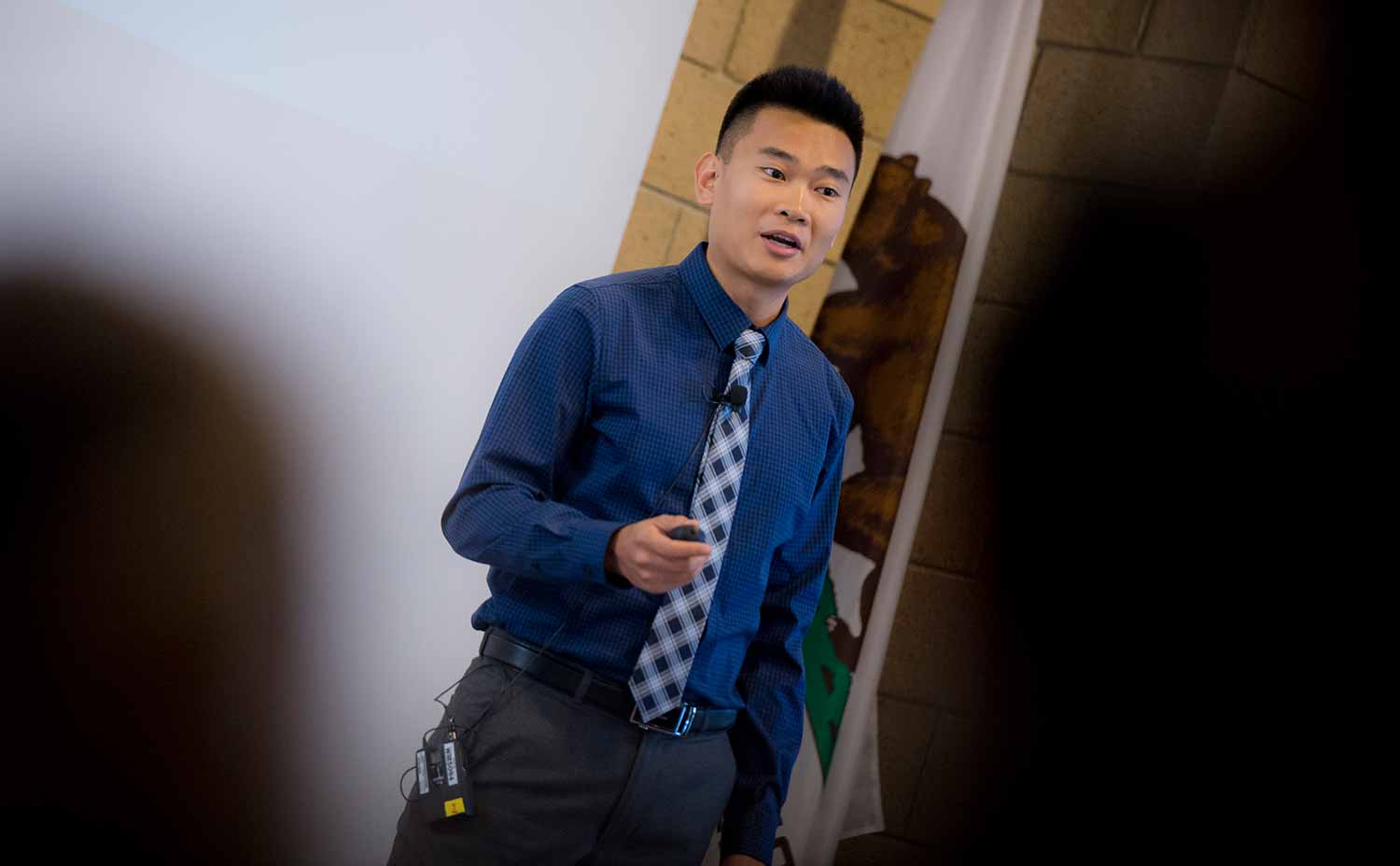 |
| Alex Phan, MAE Ph.D. Candidate Photo by Erik Jepsen/UC San Diego Publications Read UC San Diego News Center Release here |
Graduate student Alex Phan took first place at the UC San Diego-wide Grad SLAM 2015 and third place UC-wide Grad Slam competition. Both competitions challenge graduate students to present a “TED-like talk” that can explain their graduate research to a general audience and award cash prizes. As the first prize winner at the UC San Diego Grad SLAM 2015 competition held last month on April 14, Phan was chosen to represent UC San Diego at the UC-wide competition in Oakland. Phan went against 9 other graduate students from the other UC schools and took home third place for his presentation on how an intraocular pressure sensor can better detect and understand glaucoma, an eye disease that affects over 60 million people worldwide.
After completing his undergraduate degree in Bioengineering at UC San Diego, Phan is now currently pursuing his Ph.D in Mechanical and Aerospace Engineering. Phan has also completed the von Liebig Entrepreneurism Center’s NSF I-Corps Program in October 2014, where he was able to combine his background in engineering with his interests in entrepreneurship. Earlier this year, Phan took home first prize at Entrepreneur Challenge’s Elevator Pitch Competition.

Nanoengineering graduate student Aliaksandr (Alex) Zaretski represented UC San Diego at the 2015 California Dreamin’ Entrepreneurship Conference and Competition and took home $25,000 in cash, $20,000 in equity and first prize in the overall competition. The annual competition, hosted by Chapman University, draws students from the best business and entrepreneurship programs from the United States and the United Kingdom.
In 2013, Zaretski took home first prizes at the Entrepreneur Challenge at UCSD’s Elevator Pitch Competition and their $100K Business Competition with his company, GrollTex. GrollTex has an innovative technology for the synthesis of large-area graphene and has been an impressive startup success. Zarestski was awarded the von Liebig Entrepreneurism Center’s Department of Energy Fellowship and the National Science Foundation’s Graduate Research Fellowship last spring, and GrollTex recently accepted investment from the Triton Technology Fund and is in talks for a large-scale investment from another venture capital firm.
Our students show us time and again that passion and hard work don’t go unnoticed. Congratulations again to these students for their continued achievements!
Tuesday, May 12, 2015
Bitcoin experts and CSE alumna wins Chancellor's Dissertation Medal

Here is what Mihir Bellare, a professor in the department and her dissertation co-advisory had to say when outlining Meiklejohn's merits:
1. Impact: The results in Sarah’s thesis have shaped government policy. The methods in the thesis have been used to track cyber-criminals. The thesis has received significant media attention (NY Times, Washington Post, radio, TV, ...).Read our story about Meiklejohn's work here.
2. Intellectual and technical depth: The thesis introduces an innovative new experimental technique to track Bitcoins that was used not only to obtain the thesis results but is now used as a key forensic tool by law enforcement.
3. Independence: Unlike many theses, which write up group projects, this one was entirely Sarah’s work. She alone conceived the idea and methods and pushed it through from algorithms to reality.
In my 20 years of experience at UCSD, I would say that a thesis with one of the above elements is rare. To have all three in the same thesis is unique and extra-ordinary.
More media coverage of her work:
Forbes
The Economist
Wired
MIT Technology Review
KPBS
Coding with Colorful Cards: Kids Learn Arduino-based Code with Tinker the Robot
.jpg) |
| Tinker the Robot |
Meet Tinker the Robot. UC San Diego mechanical engineering alumnus
Kay Yang created him to teach and inspire young children to play with robots.
Tinker the Robot is designed to appeal to both girls and
boys – complete with an LED heart and motorized tracks – and to break down the
process of coding and hardware.
“Each accessory is either an LED light or a sensor,” said
Yang. “Using color-coded cards, kids can direct Tinker’s actions. The cards
tell Tinker to turn an accessory light on or off and how to react to feedback
from his sensors.”
The majority of programming is logic, says Yang, and once
you work out the logic, it’s easy to insert the programming language.
Here are three more things you should know about Tinker:
- Because Tinker uses Arduino-based code, kids who graduate from using the cards can plug him into the computer and reprogram him using C Programming.
- Tinker can also be an art project. Kids can draw on most of his hardware, giving them the opportunity to use their imaginations to make Tinker their own.
- He also comes with a downloadable lab notebook, designed to expose a child to scientific note-taking early on.
As a little girl, Kay loved taking things apart and learning
how they worked – except electronics. She couldn’t understand how an electronic
circuit could bring an object to life.
It wasn’t until she came to UC San Diego and enrolled in mechanical
and aerospace engineering professor Nate Delson’s Introduction to Engineering
Graphics and Design (MAE3) course – where students design and produce robots
from scratch for a competition – that she began to understand how electronics
and code work together.
“It was the first time got to play with robots, code and CAD
software,” said Yang. “I learned that mechanical engineering was a great fit
for me, but I felt that I was at a disadvantage because I hadn’t been
introduced to these concepts at an earlier age.”
As Director of UC San Diego’s Mechanical Engineering Design
Center, Nate Delson believes in project-based learning. To that end, MAE3 has recently
incorporated 3D printing into its curriculum.
“3D printing has been used by engineers for over a decade to
produce prototypes before manufacturing the real thing, whatever that may be,”
said Delson. “Now the printers are becoming a household item –in fact, many
cost just under $600.”
Yang says she felt empowered to create something that would
expose young children to electronics – that’s where Tinker comes in.
“Now is such a great time for makers,” said Yang. “I was
able to purchase a 3D printer and I’ve been producing all of my prototypes with
it,” said Yang.
Yang hopes to be able to begin mass production as soon as
possible – but to do that, she needs your help. You can back this project by
visiting Yang’s Kickstarter page here.
“We want to get this off the ground as soon as possible – our
children are our future engineers, and I really believe Tinker can inspire them
to be innovators,” said Yang.
Tinker the Robot will be available exclusively on
Kickstarter from May 4-June 4, 2015, with the first shipment to customers in
late 2015/early 2016.
Monday, May 11, 2015
ECE professor receives California grant for new project on brain research
 |
| Drew Hall, assistant professor of electrical and computer engineering at the Jacobs School. |
Drew Hall, assistant professor of electrical and computer
engineering, has been awarded a $120,000 seed grant from Cal-BRAIN, a
California initiative aimed at revolutionizing our understanding of the brain.
Hall’s project will explore using magnetic nanoscale sensors,
similar to those used in hard disk drives, to detect brain signals. These
magnetic nanosensors provide an alternative to conventional brain monitoring
methods, whose lifetimes are limited because of scar tissue formation.
Applications of this work will increase the lifetimes of neural
implants, which will ultimately lead to more effective, low-cost treatments for
brain disorders. “There is a strong need for treatment methods of neurological
diseases,” said Hall. The World Health Organization estimates that more than 50
million people worldwide suffer from epilepsy, and dementia continues to grow
at the rate of 7.7 million new cases per year.
Currently, most brain monitoring methods measure the
ionic current in the brain by making direct electrical contact with neurons
(brain cells). This contact causes scar tissue to form around the electrodes, muffling
the neural signals over time. Hall proposes measuring the magnetic field around
the neurons instead. As a result, the magnetic nanosensors avoid direct physical
contact with the neurons and are less sensitive to scar tissue formation.
“I’m excited about the team that we have put together to
tackle this high-risk, high-reward research,” said Hall. The team is also led
by Eric Fullerton, nanoengineering and electrical and computer engineering
professor and director of the Center for Magnetic Recording Research, and
Vikash Gilja, assistant professor of electrical and computer engineering.
Cal-BRAIN (the California Blueprint for Research to
Advance Innovations in Neuroscience) is a statewide project jointly led by UC
San Diego and the Lawrence Berkeley National Laboratory that was signed into
law in June 2014. It is the California complement to the federal BRAIN
Initiative announced by President Barack Obama in 2013. The 16
projects that were selected by Cal-BRAIN focus on developing new technologies
to advance our ability to monitor and analyze brain activity. More information can be found at http://cal-brain.org/ and on the UCSD News story here.
Hall also received an NSF Engineering CAREER Award in March. See story here.
Hall also received an NSF Engineering CAREER Award in March. See story here.
Friday, May 8, 2015

Thursday, May 7, 2015
Gordon Center Think Tank: The Future of Digital Health

Every year, the Gordon Engineering Leadership Center packs a room full of innovators to brainstorm the implications and uses of an emerging aspect of engineering. In the past, the Think Tank has drawn academics, innovators, and professionals from all industries to gather and collectively brainstorm on topics such as cyber security, cloud computing, automotive and avionic systems engineering, and the energy crisis. For their sixth annual Think Tank, the Gordon Center presents “The Future of Digital Health” and invites you to learn about how the use of technology can revolutionize healthcare on May 15 and 16.
The event welcomes those who want to participate in an engaging space and explore both the opportunities and the challenges of integrating technology with health care. Some confirmed speakers include Director of Qualcomm Tricorder XPRIZE Erik Viirre, President/CEO of Cambridge Life Science Strategies Cleland Landolt, Director of Nursing Innovation - Kaiser Permanente Dan Weberg, Senior Manager of Global Technologies and UCSD Alum Wilson To, CEO/Founder of Linked Objects Gioia Messinger, and our very own Bioengineering Associate Professor Todd Coleman.
.jpg) |
| Gordon Engineering Leadership Center Executive Director Dr. Ebonee Williams pictured right and Program Coordinator Kara Fukumoto Bayani pictured left. |
“I am beyond thrilled to see the level of innovation, dedication, and creativity of this year’s speakers,” said Gordon Center Executive Director Dr. Ebonee Williams. “and expect innovative solutions from the talented participants.”
Neil Gandhi, Gordon Fellow and Bioengineering Class of 2014 graduate, coordinated this year’s Think Tank on digital health with guidance from Dr. Williams and Gordon Center Program Coordinator Kara Fukumoto Bayani.
Gandhi explained that from improving data analysis to diagnosis, technology will have a sure impact on healthcare. He explained that digital health is about applying what we know how to do with mobile devices, connectivity and big data analytics to improve access to our health care system.
“This Think Tank will be looking at how digital health is a game changer, looking at how it relates bringing healthcare to all communities globally,” said Gandhi. “New wireless devices paired with smart computing is enabling better patient care, but there are still challenges in integrating technology into the clinic and changing the way we already do things.”
.jpg) |
| A group of participants from 2013's Think Tank on Cyber Security |
And the Think Tank will challenge participants to think of those solutions to translate new technologies into hospitals and medical practice. Participants will be able to share ideas through collaborative activities during the one and a half day event.
“The Think Tank has always been an engaging space for all. It’s an excellent opportunity for people to network, but also get inspired by an interdisciplinary topic with exponential growth potential,” Dr. Williams said.
Subscribe to:
Posts (Atom)