By integrating complex electrochemical sensors with simple, fairground
tattoos, nanoengineers have created a highly sensitive, wearable biosensor that
monitors electrolyte and
metabolite levels in sweat to assess
the metabolic health of a patient, and in
particular, their stamina. The temporary electrochemical tattoo relies on a
carbon fiber backbone so that it bends with the skin during normal activity
without loss of functionality and a conductive polymer that is sensitive to
pH-levels in sweat.
Thursday, March 28, 2013

On-Chip Optical Networking Devices
Information systems now rely primarily on fiber optic networks to connect and share data around the world using photons instead of electrons, but the underlying computer technology is still based on electronic chips. Researchers are hard at work developing on-chip optical networking devices such as optical waveguides, switches, and amplifiers. Electrical engineering graduate student Andrew Grieco is developing a new type of optical waveguide that promises to improve efficiency and reduce power consumption. Grieco is a Ph.D. candidate in the Ultrafast and Nanoscale Optics Group led by Shaya Fainman, professor and chair in the Department of Electrical and Computer Engineering. A newly built electron beam lithography fabrication tool house in the Nano3 Cleanroom Laboratory at the California Institute for Telecommunications and Information Technology is proving essential to his ongoing research. The e-beam lithography technology enables researchers to “write” very fine patterns on large substrates with a level of precision that was previously unavailable in the region.
Tuesday, March 26, 2013
Jacobs School Team Competes at Clinton Global Initiative Univeristy Conference
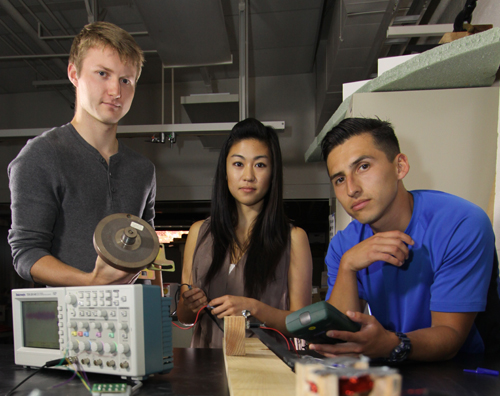
A team of Jacobs School engineering students is competing in a March-madness style competition at this year's Clinton Global Initiative University conference. Supporters have until 11 a.m. (Pacific) Thursday, March 28 to vote for their team and send them to the Sweet 16's next round. Vote now here!
The Jacobs School team is designing model homes for a village in the Philippines that uses sustainable energy sources and will withstand typhoons and earthquakes. Students are working with Gawad Kalinga, an organization that aims to end poverty in the Philippines by 2024. Some are originally from the Philippines.
Engineers are using a couple of strategies to tap into renewable energy resources for the village. They are building low-cost devices made from recyclable materials. They are developing a sand filter that can remove bacteria, microbes and dirt from water. To protect the home against typhoons, students are recommending that homes be outfitted with metal brackets, known as hurricane straps, that connect roofs to walls and stay put even in hurricane-force winds.
The team is part of Global TIES, a program that allows undergraduates to work on ambitious projects with nonprofit organizations and government agencies throughout the world.
Thursday, March 21, 2013
Get an Early Look at Emerging Technologies

Get
an early look at emerging technologies, new engineering research trends and big
ideas, all in one afternoon at the UC San Diego Jacobs School of Engineering.
Meet
potential hires among the 200+ graduate student presenters from the highly ranked
Jacobs School of Engineering at UC San Diego.
The Jacobs School of Engineering invites you to Research Expo on April 18.
Wednesday, March 20, 2013
Gauging the Seismic Safety of Retaining Walls

Researchers at the UC San Diego Jacobs School of Engineering are testing a full-scale, 7-meter-tall retaining structure on the world's largest outdoor shake table in March and April. The tests at the Englekirk Structural Engineering Center at UC San Diego, conducted on a scale never achieved before, will collect high-quality data on the overall seismic response of the structures, which are an integral and ever-growing component of our nation's infrastructure.
The data will be used to enhance the design guidelines for mechanically stabilized earth walls in the areas where earthquakes are most likely to happen. It will also help validate previous research and existing numerical models.
The tests, led by structural engineering professors Patrick Fox and Ahmed Elgamal and Ph.D. student Andrew Sander, are sponsored by the NSF's George E. Brown, Jr. Network for Earthquake Engineering Simulation (NEES).
 |
| Inside the box before it's filled. |
UC San Diego Triton Day


April 6 is the second annual Triton Day at UC San Diego! For newly admitted students, Triton Day serves as a chance to learn what it means to be a Triton, and an opportunity to accept UC San Diego’s offer of admission. For current students, staff, and faculty, the event provides a rare opportunity to rediscover the excitement that is UC San Diego, even if you are on campus every day.
Activities planned in and around the heart of campus are scheduled to take place from 9:30 a.m. to 4:30 p.m. and include live entertainment in the Price Center Plaza, the “Charting the Course” College Planning and Information Session at the Conrad Prebys Concert Hall and Thurgood Marshall College’s 35th annual Cultural Celebration.
We hope you will experience the fun April 6 – and also help us promote Triton Day! Please see the web blurb and bug that you can post on your website, add to online communications and more!
Join us! We invite the campus community—including YOU—to share your Triton pride on Saturday, April 6. To find out more, go to tritonday.ucsd.edu.
Friday, March 15, 2013
CONNECT Video: San Diego: Technology's Perfect Climate
Have you seen the great "They Came Here" video produced by CONNECT?
I also like the phrase: San Diego: Technology's Perfect Climate
I also like the phrase: San Diego: Technology's Perfect Climate
Subscribe to:
Posts (Atom)