Showing posts with label global ties. Show all posts

Wednesday, July 6, 2016

Curbing the HIV Epidemic: UC San Diego Students Design Low-Cost HIV Viral Load Monitoring System for Tijuana, Mexico

A group of students from the Jacobs School of Engineering at the University of California San Diego will spend the summer trying to curb the HIV epidemic in Tijuana, Mexico. 
Two teams from UC San Diego’s Engineering World Health (EWH) student organization and Global TIES program are combining forces this summer to bring a device they created to monitor viral load in HIV patients to a clinical setting in Tijuana, Mexico for testing. 
The teams were tasked with building a low-cost HIV monitoring device for a hospital in Mozambique. UC San Diego Health doctors Matt Strain and Davey Smith are advising both of the teams. 
“Patients in the United States on HIV therapy are tested every three to six months to make sure their treatment is still effective,” said Yajur Maker, Co-President of Engineering World Health and bioengineering undergraduate student at the Jacobs School. “This enables doctors to change the patient’s therapy if the virus has become resistant to the drugs being given.”
To establish when the virus has become resistant, the patient’s viral load or the amount of virus present in the blood, must be assessed.
“If a therapy is working, the viral load goes down,” said Maker. “If the virus has become resistant, it goes up.”
Viral load test equipment costs roughly $80,000, and $65 per test. The students from the Global TIES Open Viral Load (OVL) Team and EWH have each developed prototype viral load testing devices that cost under $2,000.  The projected cost per test is $5. 
The two teams are combining forces to take their completed devices to a clinic in Tijuana, Mexico for testing, with the help of their advisors.
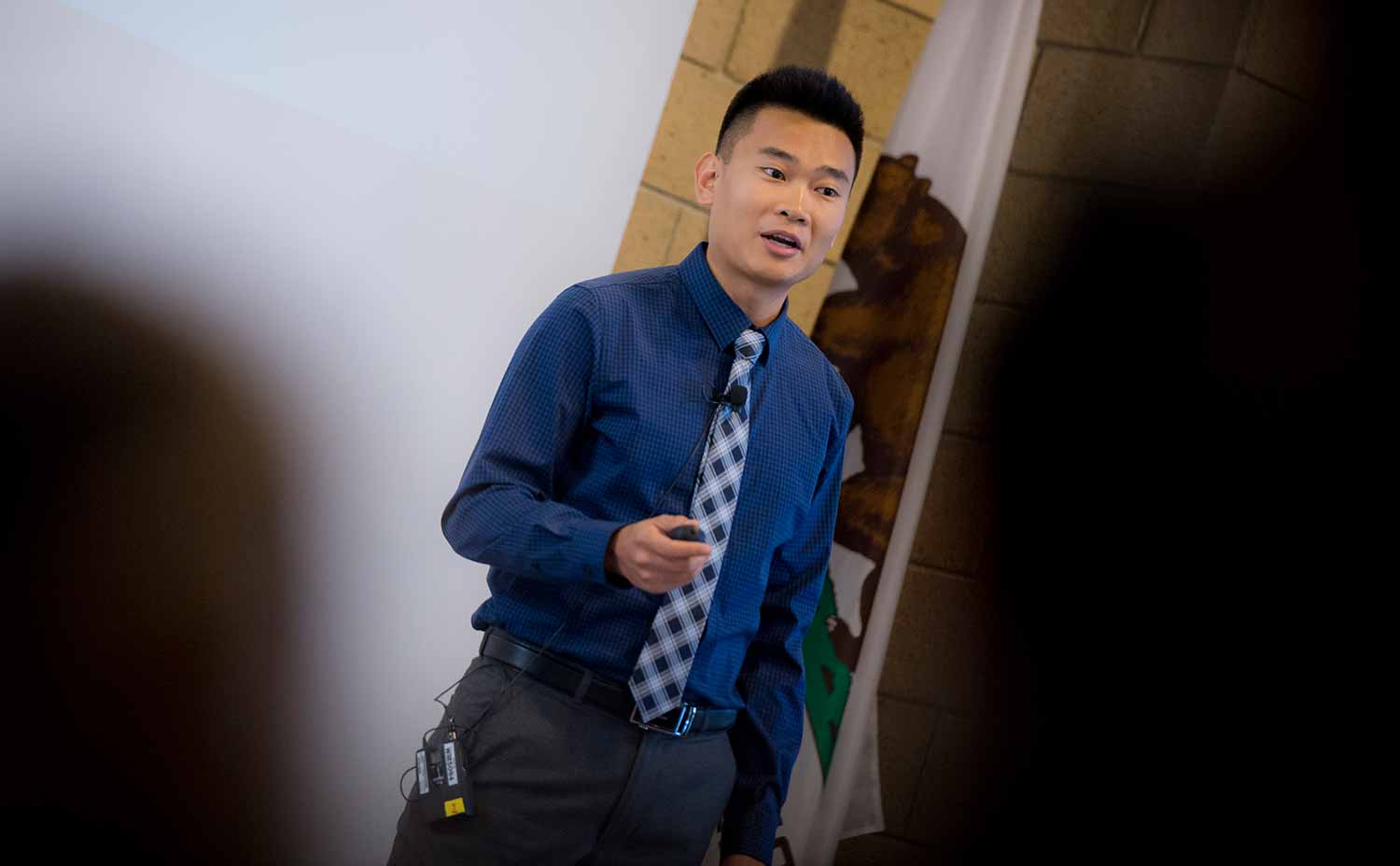
EWH Team
“We’ll adopt the best components from each team’s design and incorporate them into a system that’s ready for field implementation,” said Maker.
The teams have won over $31,000 in funding this year, including the Open Viral Load and Engineering World Health systems winning first and second place respectively in the Big Ideas at Berkeley Global Health track and receiving $2,000 each from the UCSD Social Innovation Fund. 
"The Open Viral Load Team was one of two [Global TIES] teams selected for this year's Clinton Global Initiative University, said Mandy Bratton, the Executive Director for Global TIES at UC San Diego.  “We are very proud of the work these students are doing and the impact it promises to have for HIV patients in low resource areas.”
Low-Cost HIV Monitoring
The key is determining the viral load, or the copies of HIV present in the body. After a certain threshold, or above a certain number of copies, the virus is determined to be resistant to HIV therapy, and patients must start new therapies. However, in low resource settings and without the necessary equipment, changing therapies is nearly impossible for doctors to justify.
The OVL and EWH teams are approaching the problem differently. In EWH’s case, the device consists of a low-cost centrifuge, PCR thermocycler, and a gel electrophoresis box.
The centrifuge, part of the Open Viral Load HIV-Monitoring device, processes blood.
“The centrifuge processes the blood so that we can get to the viral RNA,” said Maker. “After we extract the RNA, we amplify a gene specific to HIV using the thermocycler. Finally, we run it through the gel box to see whether viral RNA is present in large quantities. This helps doctors make the call on whether the patient’s HIV medication is not working. This process isn’t novel, but we’re making it accessible to hospitals and clinics in low-resource areas, such as Tijuana, which is so close to home.”
The difference between EWH’s device and the device the Global TIES team has built is the output.
“The difference is a qualitative versus a quantitative output. EWH’s device has a qualitative yes or no output, identifying for the doctor when a viral load threshold has been reached,” said Maker. “On the other hand, the OVL Team has built a device that quantifies the amount of virus present.”
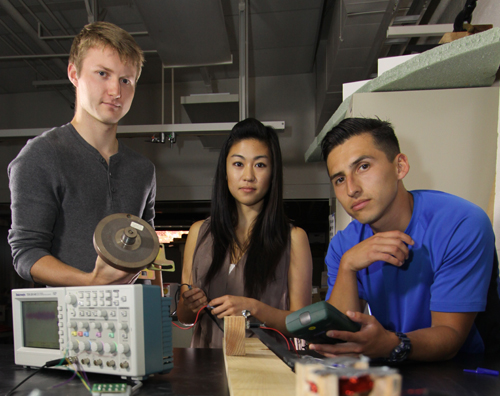
Hayley Chong and Kirk Hutchison are part of the OVL Team. 
Chong is a third year bioengineering major. “I chose Global TIES as a freshman because every student I met that was in the program was passionate about their project,” said Chong.
Hutchison, a second year biology major, chose to participate in Global TIES after hearing a talk by a Global TIES member at an event.
“Global TIES is the reason I came to UC San Diego,” said Hutchison.
The two joined the OVL Team at the same time, after taking the introductory course  in the Global TIES program. 
“We decided to come up with a way to quantify the viral load,” said Chong. “We started with a microwell chip – once we extract the RNA, we can deposit it on the microwell chip and use a fluorescent probe to detect the number of copies in each sample. If five wells on the chip light up, there are five copies of the virus.”
The device is also advantageous because its components can be used separately to identify other diseases. Students will also be working with Dr. Davey Smith this summer to adapt the device as a rapid response test for the Zika virus.
Impact
Over the course of the summer, groups of students from the two teams now look to clinically validate the designs and begin field implementation. Lab testing will continue under Drs. Strain and Smith here in the U.S. and with their new partner Dr. Jose Roman Chavez Mendez at the Universidad Autónoma de Baja California (UABC) in Tijuana. With the teams collaborating and working together this summer, the future looks bright as they look to make an impact on the first of many low-resource settings.

Thursday, August 13, 2015

Entrepreneurism & Leadership Programs Spotlight Series: Regina Caluya, Chemical Engineering '16

Regina Caluya, Chemical Engineering '16
From Cebu, Philippines, chemical engineering student Regina Caluya has focused her education and career towards making a strong social impact through science and engineering. At the age of 18, Regina emigrated to the States with her family in 2009 and enrolled at UC San Diego as a transfer student in 2013. At UCSD, Regina has been involved in Global Teams in Engineering Service (Global TIES) and the UC San Diego chapter of American Institute of Chemical Engineers (AIChe at UCSD), specifically the Chem E Car project to construct a small chemically powered car.


Regina enrolled in Global TIES last Spring and joined One Village Philippines (OVP), a team partnered with Gawad Kalinga’s (GK) Enchanted Farm to develop easily replicable, sustainable technologies to be adopted in rural communities in the Philippines, a country that is struck by approximately 15 typhoons annually. Regina has found it to be a very special opportunity to be a part of OVP and help GK’s mission.  “It’s been wonderful to gain experience and give back to your motherland,” said Regina. “My heart really goes into this. It was eye opening to be there… I was able to see the condition of my country and realized that we can do something to change or improve their condition.”


One Village Philippines Team and Global TIES Advisor Mandy Bratton
with local Filipinos at the Enchanted Farm.
This summer, OVP brought the design for the second iteration of their solar street lamp back to the Philippines, where scavenged for the necessary materials and taught some of the local Filipinos how to replicate the lamp at GK’s Enchanted Farm. “We were humbled by their practical skills,” said Regina. “They were able to wire the poles faster than us. Even though as UCSD students we have a world class university education, there are still people who know better than us.”


After graduation, Regina hopes to work for a renewable energy company, but for her last year at UCSD, Regina sees herself continuing her work with AIChe and OVP. This year, OVP has plans to pursue a brand new sustainable project, possibly one that involves relieving the whole Enchanted Farm community’s reliance on the grid.


“Working with OVP really helped me realize what career path I want to take. This summer I’m working as a research intern for Global Energy Network Institute, and I’m writing an executive summary on the possibility of making the Philippines completely renewable (hopefully by 2030), including the possible mixes of renewable energy.”

To learn more about the Global TIES One Village Philippines Project, read here.

Thursday, May 21, 2015

Student Teams Win Over $45K in Recent Competitions

This last month, students and teams from the Entrepreneurism and Leadership Programs competed in several citywide, statewide and nationwide business competitions, and collectively, two student teams and two graduate students took home over $45000 in cash prizes. UC San Diego student teams ByStanders to Upstanders and Open Viral Load (previously named VivaScope) each won $10,000 of award funding for their projects from the San Diego Social Innovation Challenge. Graduate student Alex Phan won $2,500 for placing in first at the UC San Diego Grad Slam and $1,000 for placing in third at the first UC-wide Grad Slam competition. And, graduate student Aliaksandr Zaretski took home $25,000 cash and $20,000 in equity for receiving first place at Chapman University’s California Dreamin’ nationwide entrepreneurial contest.

The San Diego Social Innovation Challenge is an annual competition hosted by the University of San Diego and their Center for Peace and Commerce. The competition aims to promote, guide and support student-driven ideas to launch or contribute to social enterprises, and has several rounds of idea labs and perfecting project pitches and business models. The Social Innovation Challenge had over 100 project submissions from San Diego university students and three rounds of challenges and project eliminations. For the final award ceremony, the remaining eight USD teams and eight San Diego-wide teams gave 90-second pitches in front of a live panel of judges. Of those eight San Diego-wide teams, four teams came from UC San Diego.

After making the final pitch competition, Global TIES team Open Viral Load partnered with Engineering World Health, another UCSD finalist team of the Social Innovation Challenge, deciding that it would be beneficial to move forward in the competition together. The teams presented one pitch on their collaborative social venture and received $10,000 to fund their projects that focus on expanding the access of HIV testing. mystartupXX team Bystanders to Upstanders (B2U) also took home $10,000 for their application to encourage and gamify volunteer work.

Alex Phan, MAE Ph.D. Candidate
Photo by Erik Jepsen/UC San Diego Publications
Read UC San Diego News Center Release here
Graduate student Alex Phan took first place at the UC San Diego-wide Grad SLAM 2015 and third place UC-wide Grad Slam competition. Both competitions challenge graduate students to present a “TED-like talk” that can explain their graduate research to a general audience and award cash prizes. As the first prize winner at the UC San Diego Grad SLAM 2015 competition held last month on April 14, Phan was chosen to represent UC San Diego at the UC-wide competition in Oakland. Phan went against 9 other graduate students from the other UC schools and took home third place for his presentation on how an intraocular pressure sensor can better detect and understand glaucoma, an eye disease that affects over 60 million people worldwide.


After completing his undergraduate degree in Bioengineering at UC San Diego, Phan is now currently pursuing his Ph.D in Mechanical and Aerospace Engineering. Phan has also completed the von Liebig Entrepreneurism Center’s NSF I-Corps Program in October 2014, where he was able to combine his background in engineering with his interests in entrepreneurship. Earlier this year, Phan took home first prize at Entrepreneur Challenge’s Elevator Pitch Competition.

Nanoengineering graduate student Aliaksandr (Alex) Zaretski represented UC San Diego at the 2015 California Dreamin’ Entrepreneurship Conference and Competition and took home $25,000 in cash, $20,000 in equity and first prize in the overall competition. The annual competition, hosted by Chapman University, draws students from the best business and entrepreneurship programs from the United States and the United Kingdom.


In 2013, Zaretski took home first prizes at the Entrepreneur Challenge at UCSD’s Elevator Pitch Competition and their $100K Business Competition with his company, GrollTex. GrollTex has an innovative technology for the synthesis of large-area graphene and has been an impressive startup success. Zarestski was awarded the von Liebig Entrepreneurism Center’s Department of Energy Fellowship and the National Science Foundation’s Graduate Research Fellowship last spring, and GrollTex recently accepted investment from the Triton Technology Fund and is in talks for a large-scale investment from another venture capital firm.

Our students show us time and again that passion and hard work don’t go unnoticed. Congratulations again to these students for their continued achievements!

Friday, April 25, 2014

These two Global TIES teams are finalists in the Social Innovation Challenge at the University of San Diego

Congratulations to the two Global TIES team that are finalists in the University of San Diego's citywide Social Innovation Challenge.
The Fiji Kindergarten team is designing a kindergarten campus from salvaged shipping containers in partnership with the Loloma Foundation in Fiji.
The One Village Philippines team is designing sustainable technologies, including solar-powered lamps, in partnership with Gawad Kalinga, a nonprofit in the Philippines.
The competition is funded by the Moxie Foundation and the winning teams are eligible to take home a $17,500 prize.
Check out the videos describing the team's projects.
The One Village Philippines team:
The Fiji Kindergarten team:

Wednesday, February 26, 2014

Learning design and helping victims of Hurricane Haiyan

Students in ENG 100A got to try their hand at building prototypes and then testing them on other users--in this case their fellow students. The prototypes represented solutions that could be deployed in the Philippines, where the Jacobs School's Global TIES program works with Gawad Kalinga, a local non-profit organization. The prototypes were designed in response to problems created by Typhoon Haiyan, better known as Typhoon Yolanda in that country. All the while, students were learning about the human-centered design process.


Tuesday, March 26, 2013

Jacobs School Team Competes at Clinton Global Initiative Univeristy Conference


A team of Jacobs School engineering students is competing in a March-madness style competition at this year's Clinton Global Initiative University conference. Supporters have until 11 a.m. (Pacific) Thursday, March 28 to vote for their team and send them to the Sweet 16's next round. Vote now here!

The Jacobs School team is designing model homes for a village in the Philippines that uses sustainable energy sources and will withstand typhoons and earthquakes. Students are working with Gawad Kalinga, an organization that aims to end poverty in the Philippines by 2024. Some are originally from the Philippines.

Engineers are using a couple of strategies to tap into renewable energy resources for the village. They are building low-cost devices made from recyclable materials. They are developing a sand filter that can remove bacteria, microbes and dirt from water. To protect the home against typhoons, students are recommending that homes be outfitted with metal brackets, known as hurricane straps, that connect roofs to walls and stay put even in hurricane-force winds.

The team is part of Global TIES, a program that allows undergraduates to work on ambitious projects with nonprofit organizations and government agencies throughout the world.